Contract-First API Development: The Spec as Executable Truth
A deep dive into contract-first API development with OpenAPI and Python. Learn to treat your API specification as an executable contract that validates requests, generates clients, and catches breaking changes before they ship.

The API documentation said the endpoint returned created_at as an ISO timestamp. The server returned a Unix epoch integer. The mobile team built their date parser around the docs. Three weeks of work, shipped to production, crashed on every API call.
“But the docs were updated last month,” someone said in the postmortem.
They were. The code was updated two months ago.
This is the fundamental problem with treating API documentation as a separate artifact from your code. Documentation drifts. Comments lie. Wikis become graveyards. The only source of truth is the running code - and by the time you discover a mismatch, you’ve already shipped broken integrations.
Contract-first API development inverts this. You write the specification first, then generate and validate everything from it. The spec isn’t documentation - it’s an executable contract that your code must obey.
What “Contract-First” Actually Means
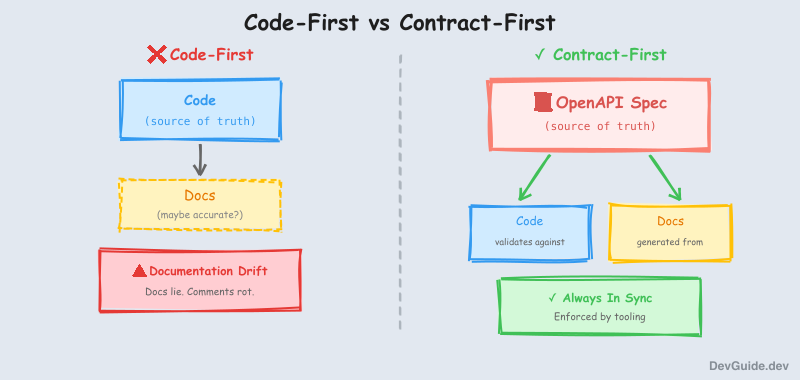
In code-first development, you write your handlers, maybe add some decorators, and generate documentation as an afterthought. The code is the source of truth; the docs are a reflection that may or may not be accurate.
Contract-first flips this:
- Design the API specification before writing any implementation code
- Validate requests and responses against the spec at runtime
- Generate code (server stubs, client SDKs) from the spec
- Enforce the contract in CI - reject changes that violate it
The specification becomes the single source of truth. Your code must conform to it, not the other way around.
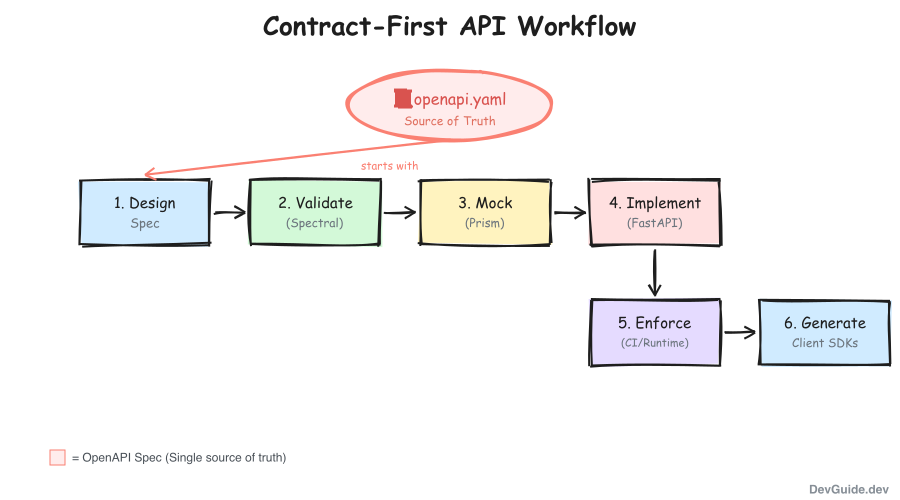
This isn’t just a documentation strategy. It’s a fundamentally different way of thinking about API development - one where the interface contract is a first-class engineering artifact, not a byproduct.
The Task Tracker API
Let’s build something real. We’ll create a task tracker API with four endpoints:
| Method | Path | Description |
|---|---|---|
POST | /tasks | Create a new task |
GET | /tasks | List all tasks (with filtering) |
GET | /tasks/{task_id} | Get a specific task |
PATCH | /tasks/{task_id} | Update a task |
Simple enough to understand, complex enough to show real patterns: request validation, query parameters, path parameters, error responses, and partial updates.
Step 1: Write the Specification First
Before writing a single line of Python, we define the contract. This is the complete OpenAPI 3.1 specification for our task tracker:
# openapi.yaml
openapi: 3.1.0
info:
  title: Task Tracker API
  description: A simple task tracking API demonstrating contract-first development
  version: 1.0.0
  contact:
    name: API Support
    email: api@example.com

servers:
  - url: http://localhost:8000
    description: Local development

paths:
  /tasks:
    post:
      operationId: createTask
      summary: Create a new task
      description: Creates a new task and returns the created resource
      tags:
        - tasks
      requestBody:
        required: true
        content:
          application/json:
            schema:
              $ref: '#/components/schemas/TaskCreate'
            examples:
              basic:
                summary: Basic task
                value:
                  title: 'Review pull request'
                  description: 'Review the authentication refactor PR'
                  priority: 'high'
              minimal:
                summary: Minimal task
                value:
                  title: 'Quick fix'
      responses:
        '201':
          description: Task created successfully
          content:
            application/json:
              schema:
                $ref: '#/components/schemas/Task'
          headers:
            Location:
              description: URL of the created task
              schema:
                type: string
                format: uri
        '400':
          $ref: '#/components/responses/ValidationError'
        '422':
          $ref: '#/components/responses/UnprocessableEntity'

    get:
      operationId: listTasks
      summary: List all tasks
      description: Returns a paginated list of tasks with optional filtering
      tags:
        - tasks
      parameters:
        - name: status
          in: query
          description: Filter by task status
          schema:
            $ref: '#/components/schemas/TaskStatus'
        - name: priority
          in: query
          description: Filter by priority level
          schema:
            $ref: '#/components/schemas/Priority'
        - name: limit
          in: query
          description: Maximum number of tasks to return
          schema:
            type: integer
            minimum: 1
            maximum: 100
            default: 20
        - name: offset
          in: query
          description: Number of tasks to skip
          schema:
            type: integer
            minimum: 0
            default: 0
      responses:
        '200':
          description: List of tasks
          content:
            application/json:
              schema:
                $ref: '#/components/schemas/TaskList'

  /tasks/{task_id}:
    parameters:
      - name: task_id
        in: path
        required: true
        description: Unique task identifier
        schema:
          type: string
          format: uuid

    get:
      operationId: getTask
      summary: Get a specific task
      tags:
        - tasks
      responses:
        '200':
          description: Task details
          content:
            application/json:
              schema:
                $ref: '#/components/schemas/Task'
        '404':
          $ref: '#/components/responses/NotFound'

    patch:
      operationId: updateTask
      summary: Update a task
      description: Partially updates a task. Only provided fields are modified.
      tags:
        - tasks
      requestBody:
        required: true
        content:
          application/json:
            schema:
              $ref: '#/components/schemas/TaskUpdate'
      responses:
        '200':
          description: Task updated successfully
          content:
            application/json:
              schema:
                $ref: '#/components/schemas/Task'
        '400':
          $ref: '#/components/responses/ValidationError'
        '404':
          $ref: '#/components/responses/NotFound'

components:
  schemas:
    Priority:
      type: string
      enum: [low, medium, high, critical]
      description: Task priority level

    TaskStatus:
      type: string
      enum: [pending, in_progress, completed, cancelled]
      description: Current status of the task

    TaskCreate:
      type: object
      required:
        - title
      properties:
        title:
          type: string
          minLength: 1
          maxLength: 200
          description: Short description of the task
          examples:
            - 'Review pull request'
        description:
          type: string
          maxLength: 2000
          description: Detailed description of what needs to be done
        priority:
          $ref: '#/components/schemas/Priority'
          default: medium
        due_date:
          type: string
          format: date-time
          description: When the task should be completed

    TaskUpdate:
      type: object
      minProperties: 1
      properties:
        title:
          type: string
          minLength: 1
          maxLength: 200
        description:
          type: string
          maxLength: 2000
        priority:
          $ref: '#/components/schemas/Priority'
        status:
          $ref: '#/components/schemas/TaskStatus'
        due_date:
          type: string
          format: date-time

    Task:
      type: object
      required:
        - id
        - title
        - status
        - priority
        - created_at
        - updated_at
      properties:
        id:
          type: string
          format: uuid
          description: Unique identifier for the task
        title:
          type: string
        description:
          type: string
          nullable: true
        priority:
          $ref: '#/components/schemas/Priority'
        status:
          $ref: '#/components/schemas/TaskStatus'
        due_date:
          type: string
          format: date-time
          nullable: true
        created_at:
          type: string
          format: date-time
          description: When the task was created
        updated_at:
          type: string
          format: date-time
          description: When the task was last modified

    TaskList:
      type: object
      required:
        - items
        - total
        - limit
        - offset
      properties:
        items:
          type: array
          items:
            $ref: '#/components/schemas/Task'
        total:
          type: integer
          minimum: 0
          description: Total number of tasks matching the filter
        limit:
          type: integer
        offset:
          type: integer

    Error:
      type: object
      required:
        - code
        - message
      properties:
        code:
          type: string
          description: Machine-readable error code
        message:
          type: string
          description: Human-readable error message
        details:
          type: object
          additionalProperties: true
          description: Additional error context

  responses:
    ValidationError:
      description: Request validation failed
      content:
        application/json:
          schema:
            $ref: '#/components/schemas/Error'
          example:
            code: 'VALIDATION_ERROR'
            message: 'Request body failed validation'
            details:
              field: 'title'
              reason: 'must be at least 1 character'

    UnprocessableEntity:
      description: Request was valid but could not be processed
      content:
        application/json:
          schema:
            $ref: '#/components/schemas/Error'
          example:
            code: 'UNPROCESSABLE_ENTITY'
            message: 'Due date cannot be in the past'

    NotFound:
      description: Resource not found
      content:
        application/json:
          schema:
            $ref: '#/components/schemas/Error'
          example:
            code: 'NOT_FOUND'
            message: 'Task not found'
This specification is dense, but notice what it defines:
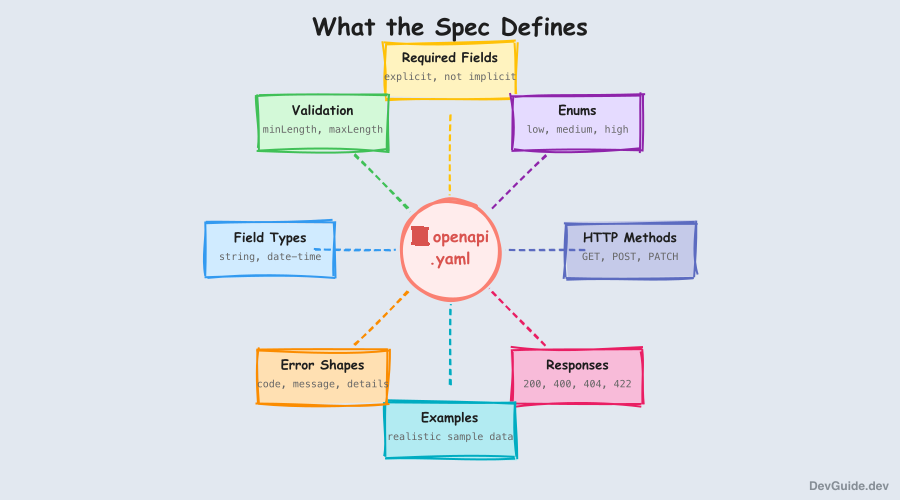
- Exact field types and formats -
created_atisstringwithformat: date-time, not an ambiguous “timestamp” - Validation constraints -
titlehasminLength: 1andmaxLength: 200 - Required vs optional fields - explicitly declared, not implicit
- All possible responses - including error shapes with examples
- Enum values -
prioritycan only below,medium,high, orcritical
This is the contract. Every request must conform to it. Every response must conform to it. If they don’t, something is broken.
Step 2: Validate the Specification
Before implementing anything, we validate that our spec is correct. We’ll use Spectral, the industry-standard OpenAPI linter.
npm install -g @stoplight/spectral-cli
spectral lint openapi.yaml
Spectral catches issues like:
- Missing operation IDs
- Inconsistent naming conventions
- Missing response schemas
- Security definition problems
For stricter validation, create a .spectral.yaml ruleset:
# .spectral.yaml
extends: ['spectral:oas']

rules:
  operation-operationId: error
  operation-description: warn
  oas3-valid-schema-example: error

  # Custom rule: all responses must have examples
  response-must-have-example:
    given: '$.paths.*.*.responses.*.content.application/json'
    then:
      field: 'example'
      function: truthy
Run with your custom rules:
spectral lint openapi.yaml --ruleset .spectral.yamlStep 3: Mock the API Before Implementation
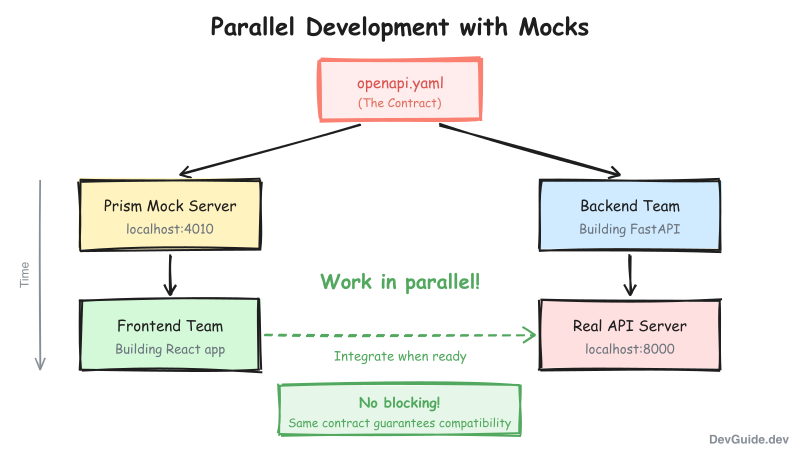
Here’s where contract-first pays its first dividend. Before writing any Python, we can run a fully functional mock server using Prism:
npm install -g @stoplight/prism-cli
prism mock openapi.yaml
Now you have a working API at http://localhost:4010:
# Create a task - returns example from spec
curl -X POST http://localhost:4010/tasks \
  -H "Content-Type: application/json" \
  -d '{"title": "Test task"}'

# Returns 400 if validation fails
curl -X POST http://localhost:4010/tasks \
  -H "Content-Type: application/json" \
  -d '{"title": ""}'  # Empty title violates minLength: 1
The mock server:
- Validates all requests against the spec
- Returns example responses defined in the spec
- Returns proper error codes for invalid requests
Frontend teams can start building against this mock immediately. No waiting for backend implementation.
Step 4: Implement with Validation
Now we implement the real API. The key architectural decision: validate every request and response against the spec at runtime.
We’ll use FastAPI with openapi-core for validation. Here’s the project structure:
task-tracker/
├── openapi.yaml              # The contract (source of truth)
├── app/
│   ├── __init__.py
│   ├── main.py              # FastAPI application
│   ├── validation.py        # OpenAPI validation middleware
│   ├── models.py            # Pydantic models (generated from spec)
│   ├── routes/
│   │   └── tasks.py         # Task endpoints
│   └── storage.py           # In-memory storage for demo
├── tests/
│   ├── test_contract.py     # Contract compliance tests
│   └── test_tasks.py        # Functional tests
├── scripts/
│   └── generate_client.py   # Client SDK generation
├── Dockerfile
├── docker-compose.yaml
├── requirements.txt
└── Makefile
The Validation Middleware
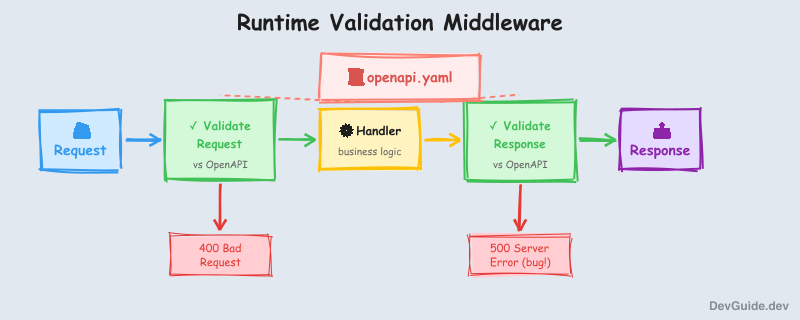
This is the core enforcement mechanism. Every request and response passes through OpenAPI validation:
# app/validation.py
from typing import Callable
from pathlib import Path

from fastapi import Request, Response
from starlette.middleware.base import BaseHTTPMiddleware
from openapi_core import OpenAPI
from openapi_core.contrib.starlette import StarletteOpenAPIRequest, StarletteOpenAPIResponse


class OpenAPIValidationMiddleware(BaseHTTPMiddleware):
    """
    Middleware that validates all requests and responses against the OpenAPI spec.

    In development: raises exceptions on validation failure
    In production: logs violations but allows requests through (configurable)
    """

    def __init__(self, app, spec_path: Path, strict: bool = True):
        super().__init__(app)
        self.openapi = OpenAPI.from_file_path(spec_path)
        self.strict = strict

    async def dispatch(self, request: Request, call_next: Callable) -> Response:
        # Validate request
        openapi_request = StarletteOpenAPIRequest(request)
        request_result = self.openapi.unmarshal_request(openapi_request)

        if request_result.errors:
            if self.strict:
                error_messages = [str(e) for e in request_result.errors]
                return Response(
                    content=json.dumps({
                        "code": "VALIDATION_ERROR",
                        "message": "Request validation failed",
                        "details": {"errors": error_messages}
                    }),
                    status_code=400,
                    media_type="application/json"
                )
            else:
                # Log but continue in non-strict mode
                logger.warning(f"Request validation errors: {request_result.errors}")

        # Process the request
        response = await call_next(request)

        # Validate response
        openapi_response = StarletteOpenAPIResponse(response)
        response_result = self.openapi.unmarshal_response(
            openapi_request, openapi_response
        )

        if response_result.errors:
            # Response validation failures are always bugs in our code
            logger.error(f"Response validation failed: {response_result.errors}")
            if self.strict:
                raise ContractViolationError(
                    f"Response does not match spec: {response_result.errors}"
                )

        return response


class ContractViolationError(Exception):
    """Raised when a response violates the API contract."""
    pass
The FastAPI Application
# app/main.py
from pathlib import Path
from fastapi import FastAPI
from fastapi.middleware.cors import CORSMiddleware

from app.validation import OpenAPIValidationMiddleware
from app.routes import tasks

SPEC_PATH = Path(__file__).parent.parent / "openapi.yaml"

app = FastAPI(
    title="Task Tracker API",
    description="Contract-first API demonstration",
    version="1.0.0",
    # Disable auto-generated docs - we serve our spec directly
    openapi_url=None,
)

# Add OpenAPI validation middleware
app.add_middleware(
    OpenAPIValidationMiddleware,
    spec_path=SPEC_PATH,
    strict=True,  # Fail on any contract violation
)

app.add_middleware(
    CORSMiddleware,
    allow_origins=["*"],
    allow_methods=["*"],
    allow_headers=["*"],
)

# Include routes
app.include_router(tasks.router)


# Serve the OpenAPI spec directly
@app.get("/openapi.yaml", include_in_schema=False)
async def get_openapi_spec():
    return FileResponse(SPEC_PATH, media_type="application/yaml")
The Task Routes
# app/routes/tasks.py
from datetime import datetime, timezone
from typing import Optional
from uuid import uuid4

from fastapi import APIRouter, HTTPException, Query, Response
from pydantic import BaseModel, Field

from app.storage import task_storage

router = APIRouter(prefix="/tasks", tags=["tasks"])


# Pydantic models matching the OpenAPI spec exactly
class TaskCreate(BaseModel):
    title: str = Field(..., min_length=1, max_length=200)
    description: Optional[str] = Field(None, max_length=2000)
    priority: str = Field("medium", pattern="^(low|medium|high|critical)$")
    due_date: Optional[datetime] = None


class TaskUpdate(BaseModel):
    title: Optional[str] = Field(None, min_length=1, max_length=200)
    description: Optional[str] = Field(None, max_length=2000)
    priority: Optional[str] = Field(None, pattern="^(low|medium|high|critical)$")
    status: Optional[str] = Field(None, pattern="^(pending|in_progress|completed|cancelled)$")
    due_date: Optional[datetime] = None


class Task(BaseModel):
    id: str
    title: str
    description: Optional[str]
    priority: str
    status: str
    due_date: Optional[datetime]
    created_at: datetime
    updated_at: datetime


class TaskList(BaseModel):
    items: list[Task]
    total: int
    limit: int
    offset: int


@router.post("", status_code=201)
async def create_task(task_data: TaskCreate, response: Response) -> Task:
    """Create a new task."""
    now = datetime.now(timezone.utc)
    task = Task(
        id=str(uuid4()),
        title=task_data.title,
        description=task_data.description,
        priority=task_data.priority,
        status="pending",
        due_date=task_data.due_date,
        created_at=now,
        updated_at=now,
    )

    task_storage.save(task)

    response.headers["Location"] = f"/tasks/{task.id}"
    return task


@router.get("")
async def list_tasks(
    status: Optional[str] = Query(None, pattern="^(pending|in_progress|completed|cancelled)$"),
    priority: Optional[str] = Query(None, pattern="^(low|medium|high|critical)$"),
    limit: int = Query(20, ge=1, le=100),
    offset: int = Query(0, ge=0),
) -> TaskList:
    """List all tasks with optional filtering."""
    tasks = task_storage.list_all()

    # Apply filters
    if status:
        tasks = [t for t in tasks if t.status == status]
    if priority:
        tasks = [t for t in tasks if t.priority == priority]

    total = len(tasks)

    # Apply pagination
    tasks = tasks[offset:offset + limit]

    return TaskList(items=tasks, total=total, limit=limit, offset=offset)


@router.get("/{task_id}")
async def get_task(task_id: str) -> Task:
    """Get a specific task by ID."""
    task = task_storage.get(task_id)
    if not task:
        raise HTTPException(
            status_code=404,
            detail={"code": "NOT_FOUND", "message": "Task not found"}
        )
    return task


@router.patch("/{task_id}")
async def update_task(task_id: str, update_data: TaskUpdate) -> Task:
    """Partially update a task."""
    task = task_storage.get(task_id)
    if not task:
        raise HTTPException(
            status_code=404,
            detail={"code": "NOT_FOUND", "message": "Task not found"}
        )

    # Apply updates
    update_dict = update_data.model_dump(exclude_unset=True)
    if not update_dict:
        raise HTTPException(
            status_code=400,
            detail={
                "code": "VALIDATION_ERROR",
                "message": "At least one field must be provided"
            }
        )

    for field, value in update_dict.items():
        setattr(task, field, value)

    task.updated_at = datetime.now(timezone.utc)
    task_storage.save(task)

    return task
Simple In-Memory Storage
# app/storage.py
from typing import Optional


class TaskStorage:
    """Simple in-memory storage for demonstration."""

    def __init__(self):
        self._tasks: dict[str, "Task"] = {}

    def save(self, task: "Task") -> None:
        self._tasks[task.id] = task

    def get(self, task_id: str) -> Optional["Task"]:
        return self._tasks.get(task_id)

    def list_all(self) -> list["Task"]:
        return list(self._tasks.values())

    def delete(self, task_id: str) -> bool:
        if task_id in self._tasks:
            del self._tasks[task_id]
            return True
        return False


task_storage = TaskStorage()
Step 5: Enforce the Contract in CI
The spec is only as useful as its enforcement. We add two layers of CI validation:
Contract Compliance Tests
These tests verify that our implementation matches the spec:
# tests/test_contract.py
"""
Contract compliance tests.

These tests verify that the API implementation conforms to the OpenAPI specification.
They catch drift between spec and implementation.
"""
import pytest
from pathlib import Path
from fastapi.testclient import TestClient
from openapi_core import OpenAPI
from openapi_core.contrib.requests import RequestsOpenAPIRequest, RequestsOpenAPIResponse

from app.main import app

SPEC_PATH = Path(__file__).parent.parent / "openapi.yaml"


@pytest.fixture
def client():
    return TestClient(app)


@pytest.fixture
def openapi():
    return OpenAPI.from_file_path(SPEC_PATH)


class TestContractCompliance:
    """Verify all endpoints conform to the OpenAPI specification."""

    def test_create_task_response_matches_spec(self, client, openapi):
        """POST /tasks response must match Task schema."""
        response = client.post(
            "/tasks",
            json={"title": "Test task", "priority": "high"}
        )

        assert response.status_code == 201

        # Validate response against spec
        result = openapi.unmarshal_response(
            RequestsOpenAPIRequest(response.request),
            RequestsOpenAPIResponse(response)
        )
        assert not result.errors, f"Response validation errors: {result.errors}"

    def test_create_task_validates_request(self, client):
        """POST /tasks must reject invalid requests per spec."""
        # Empty title violates minLength: 1
        response = client.post("/tasks", json={"title": ""})
        assert response.status_code == 400

        # Missing title violates required
        response = client.post("/tasks", json={"priority": "high"})
        assert response.status_code == 400

        # Invalid priority violates enum
        response = client.post("/tasks", json={"title": "Test", "priority": "urgent"})
        assert response.status_code == 400

    def test_list_tasks_response_matches_spec(self, client, openapi):
        """GET /tasks response must match TaskList schema."""
        # Create a task first
        client.post("/tasks", json={"title": "Test"})

        response = client.get("/tasks")
        assert response.status_code == 200

        result = openapi.unmarshal_response(
            RequestsOpenAPIRequest(response.request),
            RequestsOpenAPIResponse(response)
        )
        assert not result.errors

        # Verify structure
        data = response.json()
        assert "items" in data
        assert "total" in data
        assert "limit" in data
        assert "offset" in data

    def test_get_task_not_found_matches_spec(self, client, openapi):
        """GET /tasks/{id} 404 must match Error schema."""
        response = client.get("/tasks/00000000-0000-0000-0000-000000000000")
        assert response.status_code == 404

        result = openapi.unmarshal_response(
            RequestsOpenAPIRequest(response.request),
            RequestsOpenAPIResponse(response)
        )
        assert not result.errors

    def test_update_task_partial_update(self, client, openapi):
        """PATCH /tasks/{id} must accept partial updates per spec."""
        # Create task
        create_response = client.post(
            "/tasks",
            json={"title": "Original", "priority": "low"}
        )
        task_id = create_response.json()["id"]

        # Partial update - only status
        response = client.patch(
            f"/tasks/{task_id}",
            json={"status": "in_progress"}
        )
        assert response.status_code == 200

        result = openapi.unmarshal_response(
            RequestsOpenAPIRequest(response.request),
            RequestsOpenAPIResponse(response)
        )
        assert not result.errors

        # Verify partial update worked
        data = response.json()
        assert data["title"] == "Original"  # Unchanged
        assert data["status"] == "in_progress"  # Updated


class TestDateTimeFormat:
    """Verify datetime fields match the spec format."""

    def test_created_at_is_iso_format(self, client):
        """created_at must be ISO 8601 datetime string."""
        response = client.post("/tasks", json={"title": "Test"})
        data = response.json()

        # Must be parseable as ISO datetime
        from datetime import datetime
        created = datetime.fromisoformat(data["created_at"].replace("Z", "+00:00"))
        assert created is not None

    def test_updated_at_changes_on_patch(self, client):
        """updated_at must change when task is modified."""
        import time

        # Create
        response = client.post("/tasks", json={"title": "Test"})
        original_updated = response.json()["updated_at"]
        task_id = response.json()["id"]

        time.sleep(0.01)  # Ensure time difference

        # Update
        response = client.patch(f"/tasks/{task_id}", json={"title": "Updated"})
        new_updated = response.json()["updated_at"]

        assert new_updated > original_updated
Breaking Change Detection
Add this to your CI pipeline to catch breaking changes:
# .github/workflows/api-contract.yaml
name: API Contract Validation

on:
  pull_request:
    paths:
      - 'openapi.yaml'
      - 'app/**'

jobs:
  lint-spec:
    runs-on: ubuntu-latest
    steps:
      - uses: actions/checkout@v4

      - name: Lint OpenAPI spec
        uses: stoplightio/spectral-action@v0.8.10
        with:
          file_glob: 'openapi.yaml'

  check-breaking-changes:
    runs-on: ubuntu-latest
    steps:
      - uses: actions/checkout@v4
        with:
          fetch-depth: 0

      - name: Check for breaking changes
        uses: oasdiff/oasdiff-action/breaking@main
        with:
          base: 'origin/main:openapi.yaml'
          revision: 'openapi.yaml'
          fail-on-diff: true

  contract-tests:
    runs-on: ubuntu-latest
    steps:
      - uses: actions/checkout@v4

      - name: Set up Python
        uses: actions/setup-python@v5
        with:
          python-version: '3.12'

      - name: Install dependencies
        run: pip install -r requirements.txt

      - name: Run contract tests
        run: pytest tests/test_contract.py -v
The oasdiff check is particularly powerful - it knows the difference between breaking and non-breaking changes:
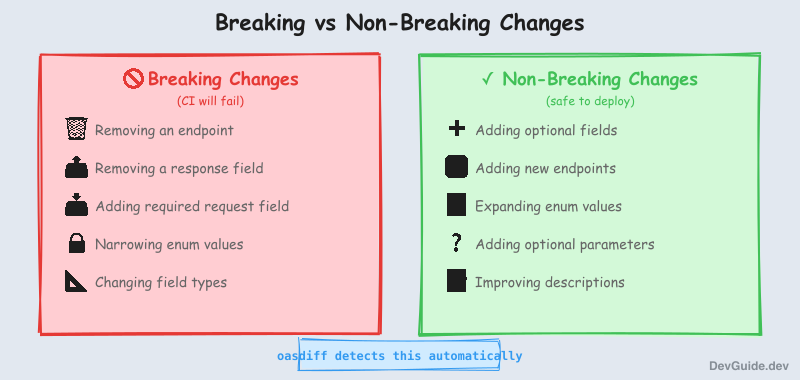
Breaking changes (will fail CI):
- Removing an endpoint
- Removing a required response field
- Adding a required request field
- Narrowing an enum’s allowed values
Non-breaking changes (allowed):
- Adding optional fields
- Adding new endpoints
- Expanding enum values
- Adding optional query parameters
Step 6: Generate Client SDKs
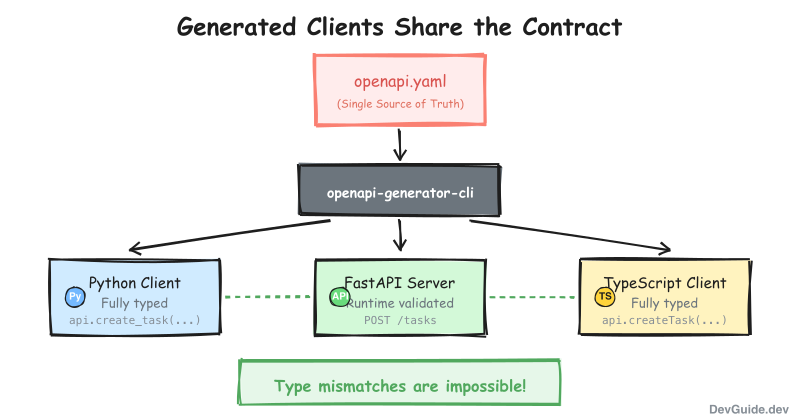
The final piece: generate type-safe client code from the spec. This ensures clients and servers always agree on the contract.
# Install OpenAPI Generator
npm install -g @openapitools/openapi-generator-cli

# Generate Python client
openapi-generator-cli generate \
  -i openapi.yaml \
  -g python \
  -o ./generated/python-client \
  --additional-properties=packageName=task_tracker_client

# Generate TypeScript client
openapi-generator-cli generate \
  -i openapi.yaml \
  -g typescript-fetch \
  -o ./generated/ts-client
The generated Python client:
# Using the generated client
from task_tracker_client import ApiClient, Configuration, TasksApi
from task_tracker_client.models import TaskCreate

config = Configuration(host="http://localhost:8000")
client = ApiClient(config)
api = TasksApi(client)

# Create task - fully typed
task = api.create_task(TaskCreate(
    title="Review PR",
    priority="high"
))

print(f"Created: {task.id}")
print(f"Status: {task.status}")  # IDE autocomplete works

# List with filters
tasks = api.list_tasks(status="pending", limit=10)
for t in tasks.items:
    print(f"- {t.title} ({t.priority})")
The client is generated from the same spec the server validates against. Type mismatches are impossible.
The Complete Repository
Here’s the full project setup for you to clone and run:
# Clone and setup
git clone https://github.com/devguide-dev/contract-first-task-tracker
cd contract-first-task-tracker
python -m venv venv
source venv/bin/activate
pip install -r requirements.txt

# Run the API
make run
# API available at http://localhost:8000

# Run tests
make test

# Validate spec
make lint

# Generate clients
make generate-clients
requirements.txt
fastapi>=0.109.0
uvicorn>=0.27.0
pydantic>=2.5.0
openapi-core>=0.19.0
httpx>=0.26.0
pytest>=8.0.0
pytest-asyncio>=0.23.0
Makefile
.PHONY: run test lint mock generate-clients

run:
	uvicorn app.main:app --reload --host 0.0.0.0 --port 8000

test:
	pytest tests/ -v

lint:
	spectral lint openapi.yaml

mock:
	prism mock openapi.yaml --port 4010

generate-clients:
	openapi-generator-cli generate -i openapi.yaml -g python -o generated/python-client
	openapi-generator-cli generate -i openapi.yaml -g typescript-fetch -o generated/ts-client

validate-breaking:
	oasdiff breaking origin/main:openapi.yaml openapi.yaml
Dockerfile
FROM python:3.12-slim

WORKDIR /app

COPY requirements.txt .
RUN pip install --no-cache-dir -r requirements.txt

COPY openapi.yaml .
COPY app/ app/

EXPOSE 8000

CMD ["uvicorn", "app.main:app", "--host", "0.0.0.0", "--port", "8000"]
docker-compose.yaml
version: '3.8'

services:
  api:
    build: .
    ports:
      - '8000:8000'
    volumes:
      - ./openapi.yaml:/app/openapi.yaml:ro
      - ./app:/app/app:ro
    environment:
      - STRICT_VALIDATION=true

  mock:
    image: stoplight/prism:4
    command: mock /app/openapi.yaml --host 0.0.0.0
    ports:
      - '4010:4010'
    volumes:
      - ./openapi.yaml:/app/openapi.yaml:ro
When Contract-First Doesn’t Fit
This approach has real costs:
Upfront design time: You can’t just start coding. You need to think through the API design before implementation. For exploratory prototypes, this slows you down.
Spec maintenance: The spec is now critical infrastructure. It needs reviews, versioning, and careful change management.
Tooling complexity: You’re adding linters, validators, generators, and mock servers to your stack. Each is a dependency to maintain.
Learning curve: Your team needs to understand OpenAPI syntax, validation semantics, and the tooling ecosystem.
Contract-first works best when:
- Multiple teams consume your API
- API stability matters (breaking changes are expensive)
- You’re building public/partner APIs
- Frontend and backend teams work in parallel
- You have compliance requirements around API documentation
It’s probably overkill for:
- Internal microservices with one consumer
- Rapid prototypes where the API is still being discovered
- Teams of one where you’re writing both client and server
- GraphQL APIs (which have their own schema-first approach)
The Executable Contract Mindset
The spec-as-documentation mindset treats OpenAPI like a README - nice to have, maintained when convenient, trusted cautiously.
The spec-as-executable-contract mindset treats it like code:
- It’s tested
- It’s validated in CI
- Breaking changes are caught automatically
- Violations fail the build
- Clients are generated from it, not written by hand
When your spec is an executable contract, the question “does the implementation match the documentation?” becomes meaningless. They’re the same thing. The spec IS the implementation’s interface, enforced at runtime and compile time.
The API documentation said created_at was an ISO timestamp. The server returned an ISO timestamp. Because it had no choice.
The complete working repository is available at github.com/devguide-dev/contract-first-task-tracker.